
New York Office
123 Steel Avenue New York, NY 10001 United States
Chicago Office
456 Iron Street Chicago, IL 60607 United States
Los Angeles Office
789 Metal Lane Los Angeles, CA 90015 United States

Say Hello
All Cart
- October 7, 2026
- 0 Comments
When a crankshaft journal is found damaged during an engine inspection, the first question RA Power Solutions asks is not, “Can we grind it?”
The first question is, “Why did the journal get damaged, and how much of the crankshaft is still within its permissible condition?”
That distinction matters.
We have seen crankpins where the visible scoring looked severe, but the journal could be recovered within the manufacturer’s permitted undersize. We have also seen journals that looked acceptable at first inspection but showed excessive ovality, taper, or dimensional loss when properly measured.
On a working vessel, we cannot make that decision by looking at the surface with a torch.
The crankshaft has to be measured.
The Condition of the Bearing Usually Tells Us a Story
When a crankpin is damaged, we normally want to see the corresponding bearing before deciding how to approach the crankshaft.
A wiped bearing, local overheating, heavy contact marking, or abnormal wear pattern can tell us considerably more than the damaged journal surface alone.
We look at the bearing condition and then consider what happened to the lubrication film.
A marine diesel crankshaft operates with hydrodynamic lubrication, and the journal surface has to provide the correct running condition for the bearing. If there has been a loss of oil film, contamination, incorrect clearance, or abnormal loading, simply machining the crankpin does not address the whole problem.
The cause of the damage has to be understood before the repaired engine is returned to service.
Otherwise, we may finish a perfectly machined crankpin and put it straight back into the same operating problem.
RA Power Solutions Wants Measurements Before We Want a Repair Recommendation
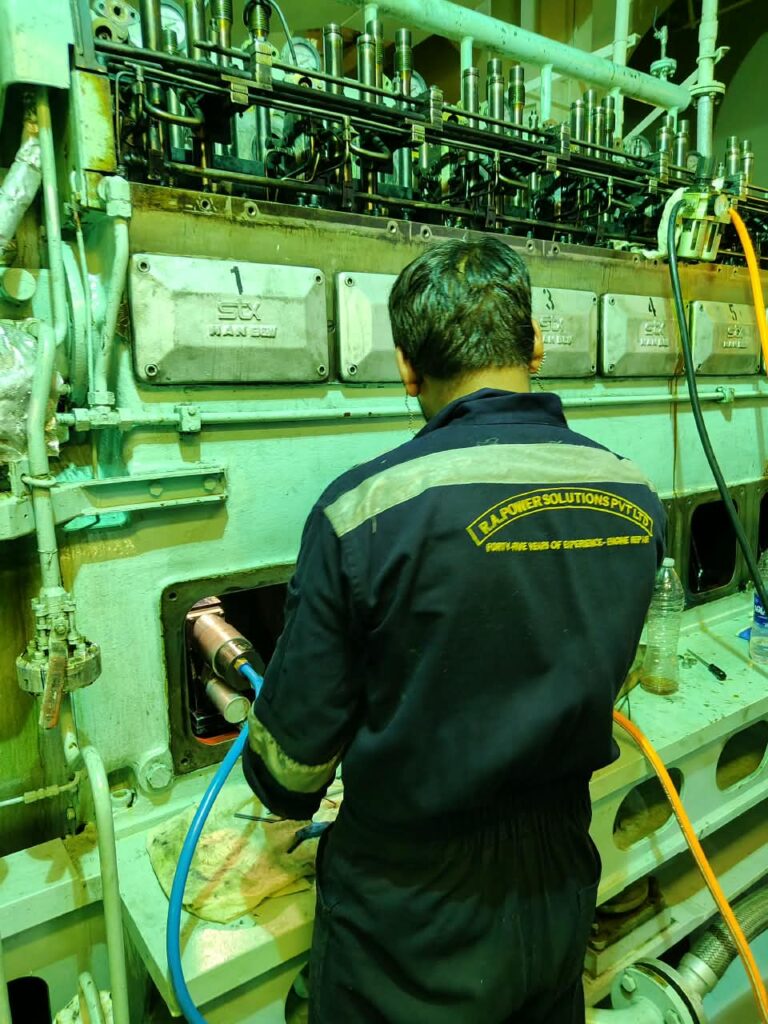
The next stage is dimensional inspection.
We measure the crankpin or main journal at different positions and establish the actual:
- Journal diameter
- Ovality
- Taper
- Wear
- Local scoring or material loss
- Fillet condition
- Existing undersize
- Available grinding allowance
This is where experience with older engines becomes important.
The dimension shown in the engine manual may be the original crankshaft dimension. The crankshaft in front of us may already have been reground during an earlier overhaul.
We have worked on crankshafts where the present condition could only be understood by looking at previous grinding records and the actual measurements taken onboard.
For this reason, we do not assume that the nominal journal diameter is the present journal diameter.
We measure it.
The Question Is How Much We Can Remove: Not How Much We Want to Remove
Once the measurements are available, we determine whether the damage can be removed while keeping the journal within the OEM regrind limits.
This is an important point during in-situ crankshaft grinding.
If a crankpin has deep scoring, the natural temptation is to remove all of the visible damage. But the amount of metal that can be removed is limited by the crankshaft specification.
The finished journal diameter must remain compatible with the permitted undersize bearing.
So the grinding decision involves the actual damaged depth, existing journal dimensions, permitted undersize, and bearing availability.
That is an engineering decision, not simply a machining decision.
Why We Pay Particular Attention to the Fillet Radius
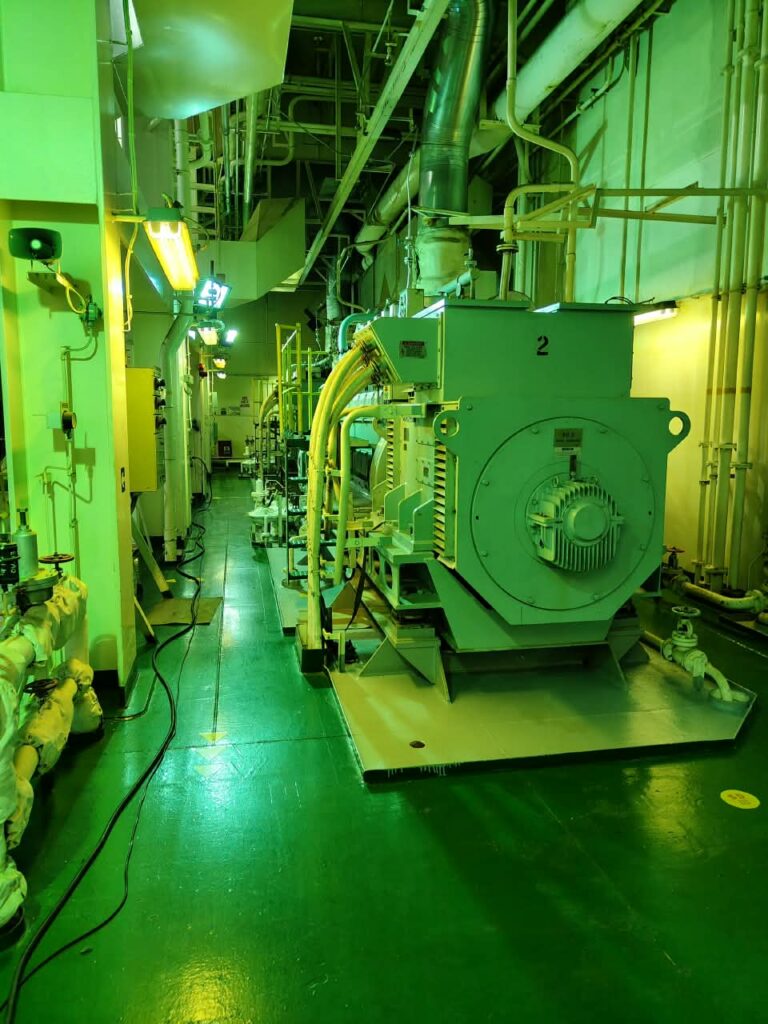
The crankshaft fillet is an area we would never treat as an incidental detail.
The fillet geometry is associated with the stress concentration at the transition between the journal and crank web. During grinding, the specified fillet radius has to be maintained.
If the grinding operation changes the radius incorrectly, the crankshaft geometry has been changed even if the journal diameter itself is correct.
This is why crankshaft grinding machine has to be correctly positioned and controlled throughout the operation.
On a marine engine, we are dealing with a component that has already accumulated considerable operating hours and cyclic loading. The repair procedure has to respect the crankshaft manufacturer’s dimensional requirements.
In-Situ Grinding Changes the Practical Repair Situation
There are situations where removing a crankshaft is simply not a sensible first option.
Consider an engine installed deep inside a vessel. Access may be restricted. Lifting arrangements may not be straightforward. Removing the crankshaft can require substantial dismantling before the actual machining work has even started.
Then there is the vessel’s schedule.
If the vessel is in drydock, the crankshaft repair has to fit into an already crowded maintenance program. If the vessel is alongside, every additional day can have an operational cost.
This is where onsite crankshaft grinding becomes a practical engineering option.
We bring the crankshaft grinding machine to the crankshaft rather than bringing the crankshaft to a workshop.
The crankshaft remains installed while the damaged crankpin or main journal is machined.
But we would not describe in-situ grinding as automatically being the better solution. The crankshaft still has to be suitable for repair; there must be sufficient grinding allowance, and access must permit the equipment to be installed and operated correctly.
The Bearing Dimension Has to Follow the Crankshaft
Another issue that frequently appears with older marine engines is bearing availability.
Suppose a crankshaft has previously been reground. The original bearing dimension may no longer be applicable.
After the new grinding operation, we establish the final as-reground crankshaft dimension. The bearing shell must then correspond to that dimension and the required running clearance.
This is where undersized bearing shells become important.
We can encounter engines for which the standard catalogue bearing is not suitable for the present crankshaft condition. In such cases, the bearing requirement has to be considered from the actual measured and as-reground crankshaft dimensions.
For an old vessel, this can be more complicated than simply ordering a bearing against the engine model.
The engine may have a repair history that is several decades old.
Ra Surface Finish Is Not a Cosmetic Check
After grinding, the journal surface condition matters.
The required Ra surface finish has to be achieved because the crankshaft journal is part of the bearing lubrication system.
A journal can have the correct diameter and still require attention to its surface condition.
We therefore check the finished surface rather than assuming that a completed grinding operation automatically means the journal is ready for service.
The same applies to geometry. We check the finished journal for ovality and taper rather than relying solely on the grinding machine settings.
Classification Requirements Still Apply to an In-Situ Repair
An in-situ repair does not mean that normal engineering documentation and classification requirements disappear.
Where the vessel is classed under DNV, ABS, Lloyd’s, or another classification society, the repair has to be considered in accordance with the applicable requirements.
The OEM crankshaft dimensions and repair limits remain important as well.
For the vessel’s superintendent or chief engineer, the useful information after the repair is therefore not simply a statement saying that the crankshaft has been ground.
We need the actual measurements.
- The journal diameter.
- The amount removed.
- The final undersize.
- The ovality.
- The taper.
- The surface condition.
- The relevant bearing dimension.
These records become part of the engine’s repair history and can be useful during the next overhaul.
What We Are Really Trying to Achieve
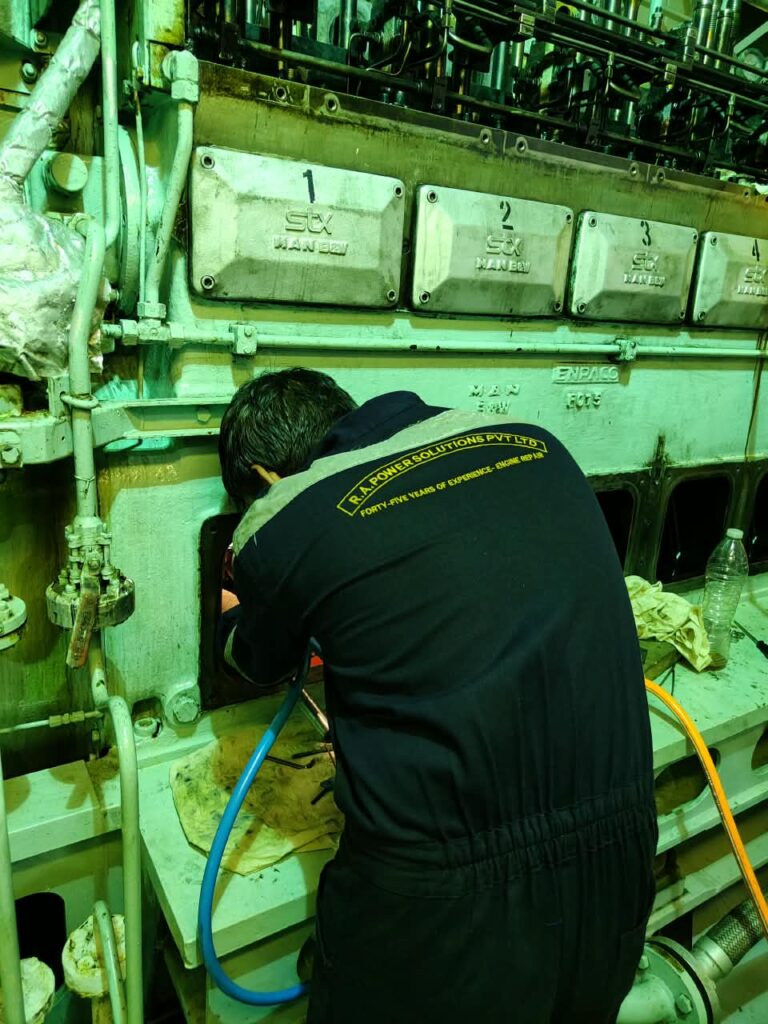
The purpose of in situ crankshaft grinding is straightforward.
We want to remove damaged material while keeping the crankshaft within its permissible dimensions and restoring the journal geometry needed for the bearing to operate correctly.
That means we have to consider the crankshaft and bearing as one operating system.
The journal diameter has to correspond with the bearing.
The surface finish has to be suitable for lubrication.
The fillet radius has to be maintained.
Ovality and taper have to remain within the applicable limits.
And the final crankshaft dimension must remain within the manufacturer’s permitted regrind range.
That is how we approach an in-situ crankshaft repair onboard.
The grinding itself is only one part of the job. The important work starts with understanding what happened to the crankshaft, what dimensions remain available, and what the manufacturer permits us to do with it.
For a vessel with restricted repair time, that assessment can be made before committing to major crankshaft removal and workshop machining.
When the measurements show that the crankshaft can be safely recovered within the applicable limits, in-situ crankshaft grinding allows the repair to be carried out with the crankshaft remaining in the engine.
That is where the method has real value in marine engine maintenance.